Baby Milestones Month by Month Are Best Read With Flexibility
The first year can make parents feel as if everything is happening at once: feeding changes, sleep shifts, new sounds, stronger muscles, brighter expressions, and sudden bursts of curiosity. A month-by-month baby milestone guide can bring welcome order to that blur, but it should never turn a baby into a checklist. Babies grow in patterns, not perfect lines. One baby may roll early and babble later, while another studies faces quietly before becoming very vocal. The most useful question is not whether a baby matches every milestone on the exact date, but whether they are becoming more engaged, more responsive, and more capable over time. Parents can use each month as a gentle lens for observation while keeping room for temperament, prematurity, health history, and family rhythm.
A: Use months as a broad guide, then consider the baby's full pattern, health history, and steady progress.
A: Try shorter sessions on your chest, across your lap, or beside an engaging face, and ask for help if distress is intense.
A: They can remind parents what to observe, but they cannot replace a pediatric conversation about persistent concerns.
A: It means walking arrived early; other areas such as language, sleep, and social development still follow their own pace.
A: Communication starts before words through gaze, cries, body movement, smiles, sounds, gestures, and shared attention.
A: Frequent supervised floor opportunities matter more than one perfect session, especially when the baby is rested and calm.
A: No. Rest supports development, and practice works better during natural awake windows.
A: New skills can make babies more alert, eager to practice, or temporarily unsettled at night.
A: Ask promptly about choking, poor weight gain, persistent refusal, stressful meals, or difficulty managing textures.
A: Look for progress across weeks, keep notes on repeated concerns, and use pediatric visits as planning conversations.
Months 0 to 2: Settling Into the World
The earliest months are less about achievement and more about adaptation. A newborn is learning how to feed, sleep, digest, regulate temperature, respond to light, and recognize the people who provide care. Parents are learning too. They are reading cries, noticing hunger cues, recovering from birth or adoption transitions, and adjusting to a relationship that changes the structure of every day.
During this period, milestones can be subtle. A baby may briefly lift their head, turn toward a voice, startle at sound, quiet when held, or gaze at a caregiver’s face. These moments matter because they show the nervous system beginning to organize around safety and connection. Parents do not need elaborate activities. Gentle talking, skin-to-skin contact, feeding support, safe sleep routines, and brief supervised tummy time are enough.
It is also normal for parents to feel uncertain. Newborn behavior is often noisy, irregular, and hard to interpret. Still, some concerns should be raised early, including poor feeding, very low responsiveness, breathing difficulty, unusual stiffness or floppiness, or lack of reaction to sound. Early questions are not overreacting; they are part of attentive care.
Months 3 to 4: More Alert, More Social, More Physical
Around the third and fourth months, many babies seem to wake up to the room. They may smile more deliberately, follow movement with their eyes, coo, bring hands toward the mouth, and push up with more strength during tummy time. Parents often notice that interaction feels less one-sided. A baby may respond to a familiar voice with a whole-body wiggle or hold a gaze long enough to make the adult feel truly recognized.
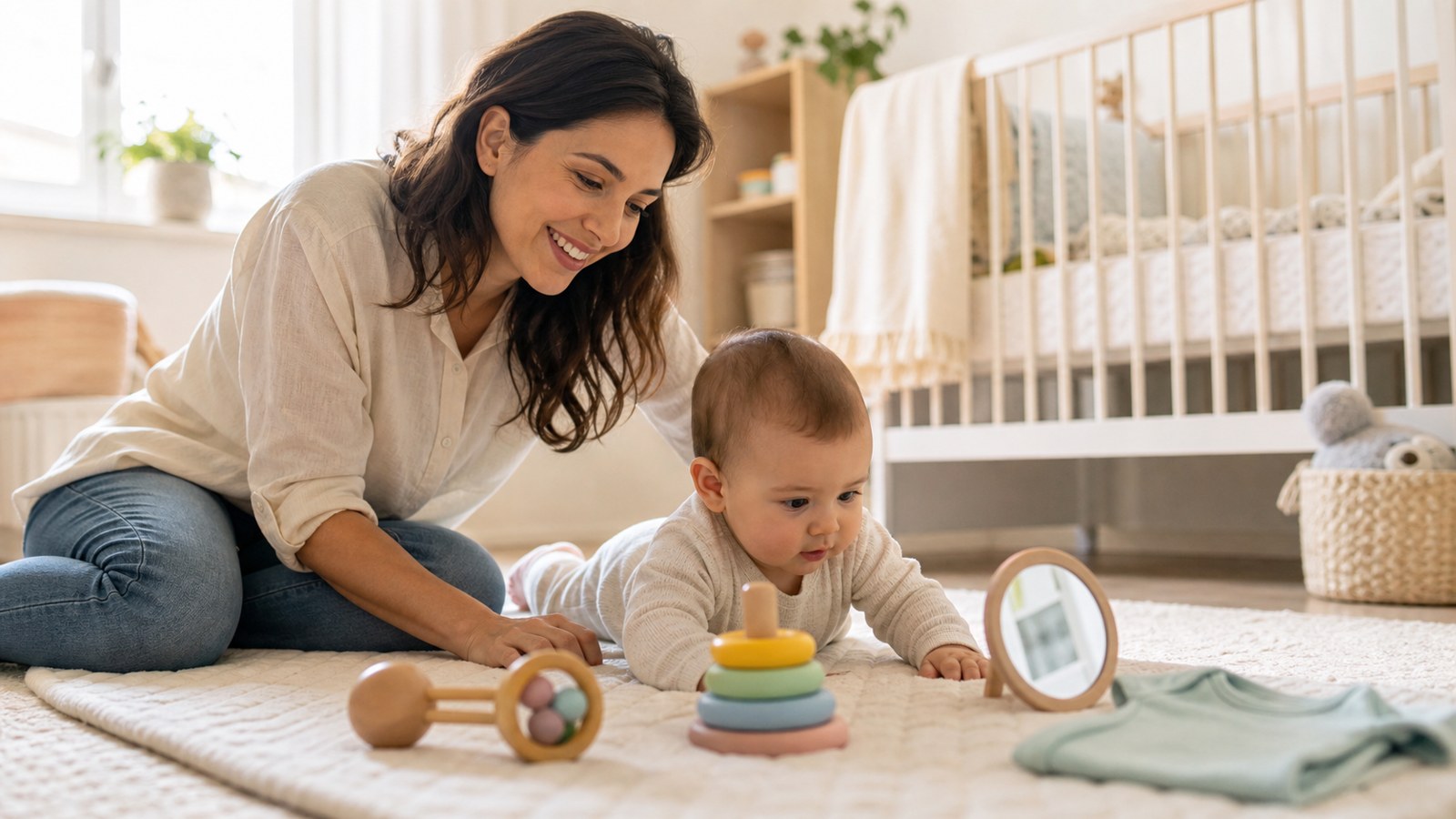
This is a good time to make play simple and responsive. A baby lying on a blanket can watch a caregiver’s face, track a toy, listen to a song, or practice reaching. The best play does not overwhelm the baby with constant stimulation. It gives the baby a chance to look, pause, respond, and rest.
Rolling may begin for some babies in this window, while others are still building strength. Instead of forcing a milestone, parents can create opportunities: supervised floor time, toys placed slightly off-center, and breaks when the baby is tired. Development is easier when practice feels inviting rather than like a daily test.
Months 5 to 6: Reaching, Sitting, Food Curiosity, and Sound Play
By the middle of the first year, many babies become more intentional with their hands and voices. They may reach for objects, transfer toys, laugh at repeated games, push up with straighter arms, or sit with support. Some begin showing interest in food, though readiness is about more than age. Posture, head control, interest, and the ability to manage food safely all matter.
Parents may feel pressure at this stage because milestone conversations become more public. People ask whether the baby is sleeping through the night, eating solids, sitting, rolling, or making certain sounds. Those questions can be friendly, but they can also create comparison. A calmer approach is to look at the baby’s own trend. Are they stronger than last month? More engaged? More curious? More able to recover with support?
Sound play is especially important. Babbling, squealing, raspberries, and repeated noises are not just cute. They are practice for breath, mouth movement, hearing, turn-taking, and social feedback. When a parent copies a sound and pauses, the baby learns that communication can move back and forth.
Months 7 to 9: Movement Experiments and Stronger Preferences
The second half of the year often brings a new level of determination. Babies may rock on hands and knees, scoot, crawl, pivot, pull toward objects, or find unexpected ways to cross a room. Some become frustrated because their desire to explore is ahead of their coordination. A safe floor area becomes more useful than any complicated toy.
This is also when preferences may become louder. A baby may reach for one caregiver, protest when a toy is removed, resist a texture, or become wary of unfamiliar people. These reactions can be tiring, but they often reflect growing memory and attachment. The baby now understands more about who is familiar, what they want, and what has changed.
Parents can support this period by making the environment safer instead of saying no all day. Move hazards, anchor furniture, create yes-spaces, and offer objects that can be explored without constant interruption. Babies learn through repetition. Dropping a spoon ten times may feel inefficient to an adult, but it is a lesson in sound, gravity, attention, and response.
Months 10 to 12: Gestures, Problem-Solving, and Early Independence
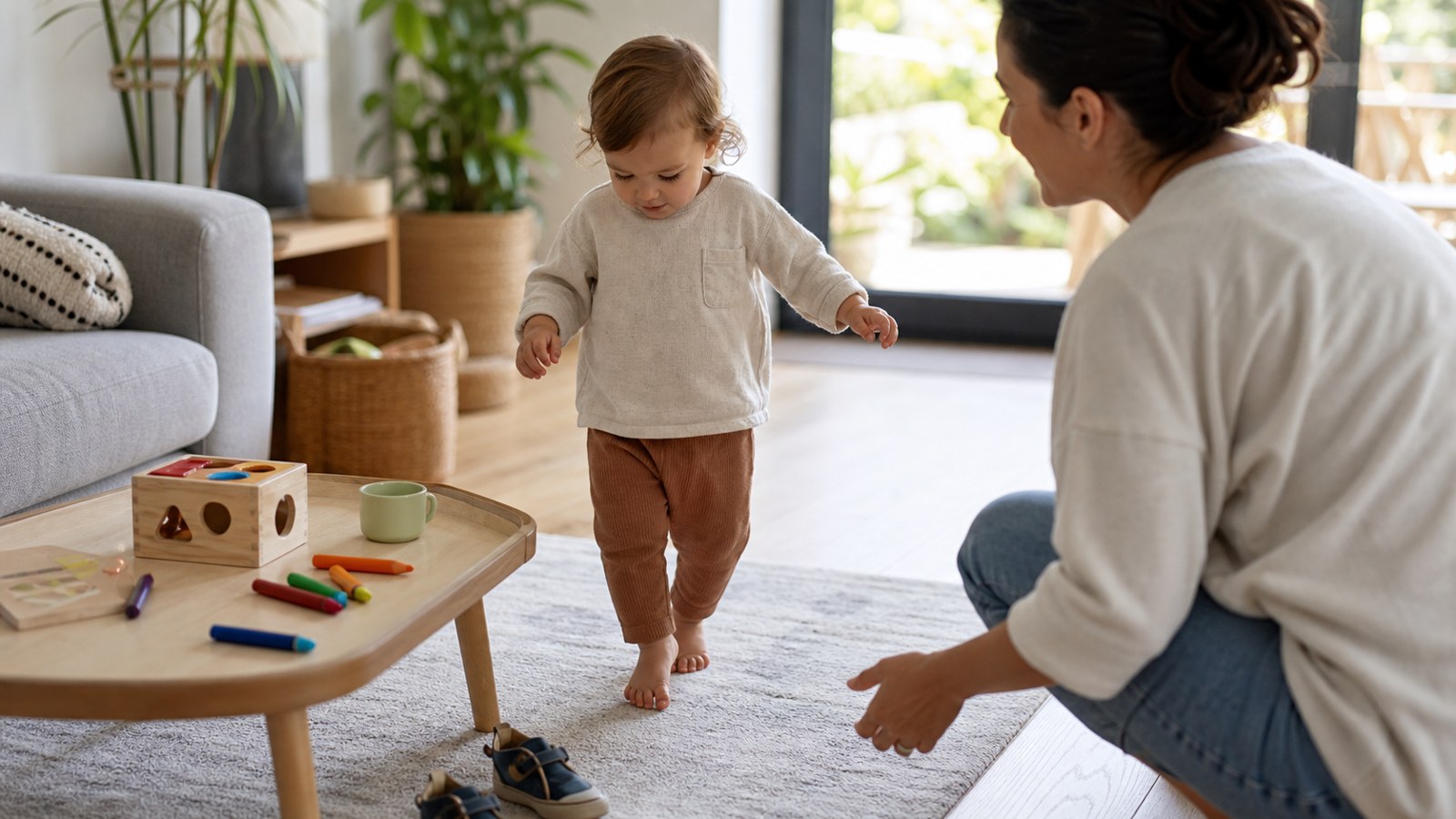
As the first birthday approaches, development can feel especially visible. Many babies use gestures, imitate actions, respond to familiar words, cruise along furniture, crawl with speed, or experiment with standing. Some take first steps; others are more focused on language, fine motor skills, or social games. The range remains wide.
Problem-solving becomes easier to see. A baby may look for a hidden object, try different ways to reach something, place items into containers, or repeat an action to create an effect. These are early thinking skills. Parents can nurture them by giving enough time for the baby to try before jumping in.
The end of the first year can also bring big feelings. A baby may want independence but still need closeness, especially when tired, hungry, or overstimulated. Gentle limits begin here: blocking unsafe actions, naming what is happening, redirecting, and staying calm. Discipline at this age is not punishment. It is protection, repetition, and teaching through the environment.
Feeding, Sleep, and Milestones Influence One Another
Parents often separate development into categories, but babies live it all together. A baby learning to crawl may sleep differently. A baby starting solids may have changes in digestion, interest, or mood. A baby gaining separation awareness may wake more often, not because the family did something wrong, but because memory and attachment are growing.
This does not mean every hard week should be dismissed as a phase. It means parents can look for patterns before blaming themselves. If sleep changes after travel, illness, teething, or a new skill, the response may be patience and routine. If feeding is persistently stressful or growth is affected, the response should include professional guidance.
Feeding milestones deserve particular gentleness because they involve the body, the senses, and the relationship between baby and caregiver. Some babies eagerly explore new textures, while others need more time to tolerate smell, touch, temperature, or the feeling of food in the mouth. Pressure can make meals more stressful. Calm repetition, safe positioning, and professional advice when needed are usually more helpful than turning every meal into a performance.
Sleep milestones are similar. Parents may hear that a baby should sleep a certain way by a certain month, then feel defeated when real life does not match the claim. Sleep is shaped by temperament, feeding, illness, family schedule, development, and environment. A predictable routine can help, but it does not erase every waking. Parents can support sleep while still responding to the baby as a person.
How Parents Can Track Without Obsessing
A simple monthly note can be more useful than constant app checking. Parents might write down what the baby enjoys, what new movement appeared, what sounds are common, what feels difficult, and what questions should be raised at the next visit. This creates a calmer record than trying to remember everything during a rushed appointment.
Photos and short videos can also help, especially when parents want to show a pediatrician a movement pattern, feeding concern, or social response. The goal is not to collect proof that the baby is perfect. It is to understand the baby clearly enough to offer the right support.
Parents can also track what helps. If a baby practices rolling best after a nap, that matters. If babbling increases when an older sibling sings, that matters too. If a baby becomes overwhelmed after a crowded errand, the family has learned something useful about stimulation and recovery. Milestone tracking should make care more personal, not more anxious.
A balanced record includes joy. Write down the funny sound, the new expression, the first time the baby reaches for a familiar person, or the game that makes everyone laugh. Development is not only a list of abilities. It is the story of a child becoming known.
When the First Year Feels Emotionally Heavy
Milestones are not only about babies. They affect parents too. A delayed skill can trigger fear, a comparison can sting, and a difficult feeding or sleep pattern can make the whole household feel fragile. Parents deserve care in that process. Exhaustion changes how problems look. Support from a partner, relative, friend, pediatrician, lactation professional, therapist, or parent group can make development feel less lonely.
The first year is a relationship being built in real time. Babies need responsive care, and caregivers need realistic expectations. When both are honored, milestones become helpful information rather than a measure of parental worth.
Parents may also grieve the version of infancy they expected. A baby with reflux, feeding challenges, medical appointments, sleep struggles, or unusual fussiness can make the year feel very different from the soft-focus images families often see. Naming that disappointment does not mean a parent loves the baby less. It means the parent is telling the truth about the load they are carrying.
The First Birthday Is a Beginning, Not a Final Exam
By twelve months, a baby has usually changed in astonishing ways, but the first birthday is not a finish line. Some babies arrive walking, some crawling, some talking with gestures, some studying everything before making their next leap. What matters most is the pattern of growth, connection, curiosity, and support.
A month-by-month guide can help parents notice that pattern. It can remind them to offer floor time, conversation, safe exploration, rest, and medical questions when needed. Used gently, it becomes a companion through the first year instead of a scoreboard. That is the kind of guide families can actually live with, because it leaves room for both wonder and uncertainty in ordinary daily care. It helps parents stay attentive without making every day feel like an exam or a race against time.