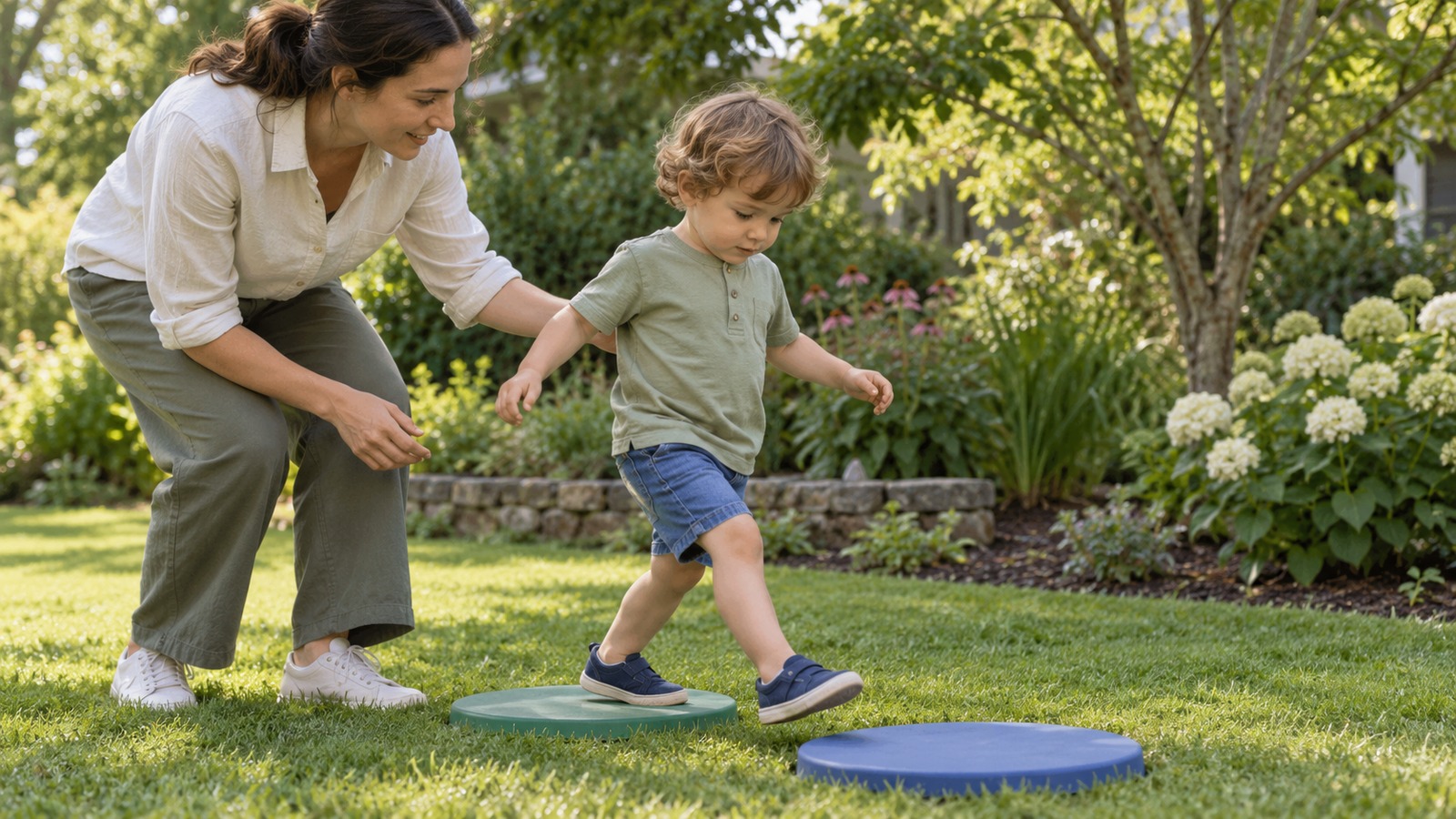
Notice How Your Child Moves, Not Just Which Skill Comes Next
Watching a child learn to sit, stand, run, or join a playground game can bring delight and uncertainty at the same time. A milestone chart offers a reference point, but it cannot show the whole child or explain every difference in movement. Gross motor skills involve large movements and the balance, strength, and coordination needed to use them. This guide helps parents understand the broad progression, interpret a few age-based examples, and make useful observations without turning play into repeated testing. It also explains why concerns deserve a conversation rather than a diagnosis from a checklist. Your child’s history, opportunities, health, and individual needs matter. Support enjoyable movement in a safe setting, and bring specific concerns to the pediatrician. If your child loses a skill, has pain, or suddenly cannot move as usual, seek prompt medical advice rather than waiting for the next milestone date.
A: No. They include large movements, position changes, balance, and other whole-body abilities.
A: The one-year CDC examples include pulling to stand and walking while holding furniture; discuss individual concerns with the clinician.
A: No. Monitoring and validated screening serve different purposes.
A: Transitions add information that a single photograph of a pose cannot show.
A: Yes. Describe both the movement and the demands of the setting.
A: No. Describe the pattern and ask for professional assessment when concerned.
A: Compare the space, equipment, assistance, and task demands with the relevant adults.
A: It may help illustrate a safely observed concern, alongside a clear description.
A: No. Contact the child's clinician promptly about loss of skills.
A: The pediatrician and the state's early intervention program can explain appropriate next steps.
| Checklist age | One selected observation |
|---|---|
| 4 months | Keeps the head steady without support while being held |
| 6 months | Rolls from the tummy onto the back |
| 9 months | Gets into a sitting position independently |
| 12 months | Walks while holding furniture |
| 18 months | Walks without holding a person or object |
| These are selections, not a complete assessment. CDC milestones describe what at least 75% of children do by an age; checklists do not replace validated screening. Discuss missing skills, loss of skills or other concerns promptly with the child’s clinician. | |
What Counts as a Gross Motor Skill?
Gross motor skills use large muscle groups to move the body or maintain a position. Holding the head steady, sitting, changing position, walking, and jumping are familiar examples. These abilities also rely on balance, planning, sensation, and coordination. A child may manage one movement more confidently than another, especially when a setting or task is unfamiliar.
Fine motor skills involve more precise movements, such as manipulating a small object. The distinction is useful for describing a concern, but real activities often combine both. Getting onto a chair and using a spoon draw on several abilities. Instead of trying to label every action perfectly, describe what the child does, what support is needed, and what seems difficult.
Movement also changes with context. A familiar room, an unhurried adult, and equipment that fits can make participation look very different from a noisy group demonstration. That does not mean a concern should be dismissed because one setting went well. It means the setting belongs in the description. Notice what the child can do comfortably, how much assistance is needed, and whether the same difficulty appears across ordinary activities. These details help a clinician decide which questions to explore. They also help adults choose a useful adjustment without inventing a diagnosis or asking the child to repeat a difficult task for every visitor.
Use Age References as Prompts for Observation
The CDC milestone checklists describe skills that most children can do by specified ages. They are tools for monitoring development and discussing concerns, rather than substitutes for validated screening or an individual assessment. Read the exact age and description instead of relying on a social media summary. A skill seen once under unusual conditions may not tell you how comfortably the child uses it in daily life. Equally, a child who refuses a demonstration on demand may use the skill during familiar play. Bring observations from ordinary settings to the clinician, including anything that worries you even if it does not appear on a list. For a child born early, ask how corrected age should be used. For a child with a known condition, ask which reference points and goals are appropriate.
Early Infancy: Position, Control, and Opportunities to Move
Early movement develops through small changes in control and the ways a baby interacts with people and the surrounding space. Parents can notice how the baby turns toward a familiar person, moves both sides of the body, and responds to a safe change in position. The aim is to observe comfort and participation, not to manufacture a performance for a video.
Provide supervised awake play in appropriate spaces and follow the clinician’s advice about positioning. A firm, clear floor area can offer movement opportunities that a seat cannot. Tummy time belongs to supervised awake periods; place babies on their backs for sleep. Adjust a play invitation when the baby shows fatigue or distress.
Do not prop a baby into an unsupported position to meet an imagined deadline. Equipment marketed as developmental does not replace responsive interaction or medical assessment. If positioning seems consistently difficult, the baby uses one side very differently, or you have another concern, describe it to the pediatrician. An early conversation can clarify what to watch and whether assessment is needed.
Later Infancy: Transitions Can Tell You More Than a Pose
A photograph of a baby sitting shows one moment. Watching how the baby gets into and out of positions can give a fuller picture of everyday movement. Notice whether the child reaches for a toy, shifts weight, and finds ways to explore an accessible space. Keep the environment safe for the abilities the baby is beginning to use.
Different movement strategies are not all interchangeable diagnoses. Avoid deciding from a single crawling style that something is definitely wrong or definitely fine. Explain the pattern to a professional if it concerns you, especially if it accompanies pain, marked asymmetry, or a loss of ability. Home observations help the conversation; they do not replace an examination.
Around the First Birthday: Supported Standing and Moving Along Furniture
Examples on the CDC one-year checklist include pulling to stand and walking while holding furniture. These are specific reference points, not a promise that every child will be walking independently on the first birthday. Make sure furniture cannot tip and that the route does not lead toward stairs, cords, or other hazards. An adult should supervise rather than assume a newly mobile baby understands danger. Notice how the child changes position and what support is used. If an expected skill is absent or movement worries you, tell the pediatrician rather than waiting for reassurance from comparisons with cousins or siblings. You do not need to prove a delay before asking for guidance. The useful next step is a clear description and an agreed plan.
From Eighteen Months to Two Years: Walking Meets New Challenges
The eighteen-month checklist includes walking without holding on. By two years, CDC examples include running, kicking a ball, and walking up a few stairs with or without help. These examples describe a developing range of movement; they do not mean a toddler is ready for unsupervised stairs or a crowded sports game.
Choose a clear space and a challenge that matches current ability. A large soft ball can make an invitation to kick easier to understand than a complicated game. On stairs, use appropriate gates and direct adult supervision. Observe what assistance is needed without repeatedly withholding help to see whether the child can manage alone.
Preschool Years: Coordination Becomes Part of More Complex Play
As preschool play becomes more varied, children encounter catching, balancing, changing direction, and coordinating actions with other people. The CDC four-year examples include catching a large ball most of the time, while the five-year checklist includes hopping on one foot. Use the current age-specific checklist for a fuller view.
A new game adds demands beyond the movement itself. Children must understand instructions, judge space, manage excitement, and sometimes wait for a turn. Difficulty in a busy group may look different from difficulty practicing a movement in a quiet place. Ask what happens in both settings before deciding what support would help.
Offer demonstrations and simple invitations without comparing children publicly. Let a child repeat an enjoyable challenge and stop when the experience becomes frustrating or unsafe. A missed catch is useful information about that attempt, not a verdict on athletic potential. Persistent difficulties that limit participation deserve discussion with the pediatrician or the relevant developmental professional.
School Age: Look at Participation as Well as Performance
School-age movement expands into recreation, physical education, transport, and everyday independence. A child may be comfortable walking and climbing but find a fast ball game difficult. Ask which part creates trouble: understanding the sequence, keeping balance, managing equipment, or coping with the pace. This level of detail is more useful than describing the child as simply clumsy.
Talk with the child and, when appropriate, teachers or coaches about access to activities. They may need different equipment, a slower demonstration, or a less crowded place to practice. If movement difficulties affect daily tasks or confidence, seek assessment rather than relying only on extra drills. Skill support should preserve dignity and opportunities to belong.
Create Practice Through Play That Has a Purpose
A useful play invitation gives a child a reason to move: reaching a toy, carrying a light object, crossing an open space, or joining a familiar game. Choose the invitation based on what the child can safely attempt now. Leave room for exploration instead of correcting every movement. You can move a target closer, make a route wider, or simplify the rules when the first version is too demanding. These adjustments change the task while keeping participation meaningful. Avoid promising that a particular toy or activity will prevent or cure a developmental delay. If a therapist has provided a home plan, follow that individualized advice and ask how everyday play can support it. Enjoyable practice and professional assessment can work together without making home feel like a testing clinic.
Record Concerns in Concrete Language
Write a short description of what you see and when it occurs. For example, distinguish difficulty getting up from the floor from reluctance to run in a noisy playground. Include whether the concern is new, how often it happens, and whether pain or fatigue accompanies it. A brief video may help if it can be captured safely and shared privately with the care team.
Include strengths and successful conditions as well. A child who manages a task with a clear demonstration may need different support from a child who cannot perform the movement even with appropriate help. Describe assistance accurately: holding a rail, using an adult’s hand, or needing physical lifting are different situations. Avoid coaching a child through a performance solely to make a checklist look complete.
Ask other caregivers for observations without inviting labels or blame. Their account may reveal a difference in surfaces, equipment, footwear, or expectations. Gather only what helps the clinical discussion. A concise record of daily function is usually more useful than a long collection of comparisons with other children.
Know When to Ask for Assessment
Contact the pediatrician when your child is not meeting an expected milestone, movement seems persistently difficult, or you have concerns about development. Loss of skills deserves prompt attention. Sudden weakness, inability to bear weight, significant injury, or other acute symptoms may require urgent medical care. Follow local emergency guidance for a child who appears seriously unwell.
For a developmental concern, ask what screening or referral is appropriate and when you should expect follow-up. In the United States, families can also ask their state’s early intervention program about assessment for children under three; older children may access evaluation through the local school system. Eligibility and pathways vary. Keep asking for a clear next step if the concern remains unresolved.
Make Expectations Useful to the Child You Have
An age guide works best when it helps adults notice, support, and communicate. It becomes less useful when every family outing turns into a comparison or a test. Keep providing safe opportunities to move while following through on concerns. A child does not have to earn encouragement by being the fastest or reaching the next skill first. Celebrate participation and the practical achievements that matter in daily life. With the care team, agree on goals that fit the child’s needs and review them when circumstances change. Understanding gross motor development means seeing both the broad age references and the individual child using movement to explore, connect, and take part in the world.